Overview
Nearby Lifesaving Resources
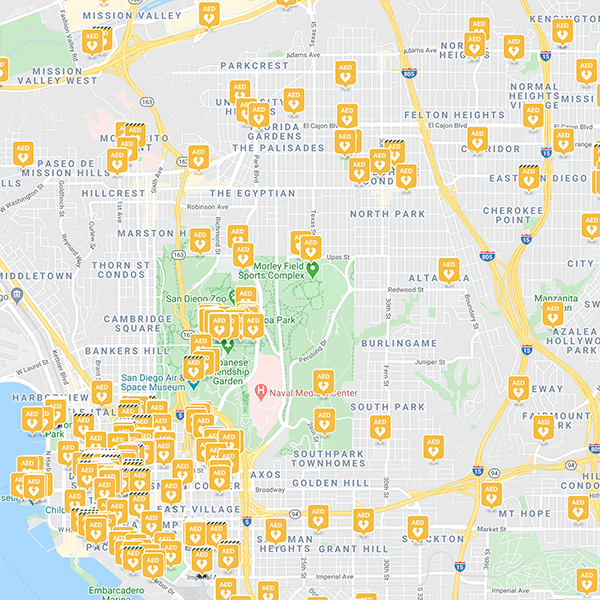
The National Emergency AED + Resource (NEAR) Registry provides centralized access to AEDs, bleeding control kits, epinephrine and naloxone, so they can be identified and deployed during life-threatening emergencies. The NEAR Registry integrates with emergency communication centers so telecommunicators can alert callers to nearby lifesaving resources.
The NEAR Registry consolidates data from all available sources to create a unified, authoritative source of resource locations for emergency use. These sources include manufacturers and distributors, program management companies, governmental entities, school districts, airports, and partner organizations and NGOs. Many communities also collect locations in partnership with local businesses and places of assembly.
The NEAR Registry mobile app offers a simple method to add AEDs and emergency resources to the registry. Resource locations can be viewed by anyone using the NEAR Registry app, PulsePoint Respond, or an agency-hosted resource map. In communities using PulsePoint Respond, AED owners and responsible parties can receive real-time alerts when their registered AED is needed nearby.
The NEAR Registry is hosted and administered by the PulsePoint Foundation. PulsePoint provides access to the NEAR Registry, administrator training, and support services at no charge.
App
NEAR Registry App


It takes a community
LET'S BUILD IT TOGETHER
- Complete management of AEDs and other emergency resources in the National Emergency AED + Resource (NEAR) Registry.
- Support for bleeding control kits, epinephrine and naloxone, whether paired with an AED or on their own.
- Real-time alerts when a nearby cardiac arrest may require an AED.
- Predictive data entry simplifies and improves record accuracy, including open/closed hours based on linked public data sources.
- Support for 24/7 "always available" resources, including access code management for locked cabinets.
- Support for consumable expiration reminders and regulatory notices.
- Surveillance of resources allows for issue reporting and notifications to responsible parties.
- Smartcabinet integration enables remote activation of cabinet lights, sounds, and access.
- Multilingual support with automatic language detection and WCAG-conformant accessibility.
- FirstNet Certified™ demonstrating 99.99% availability and independent third-party security, data privacy, and performance assessments.
AED-needed Alerts
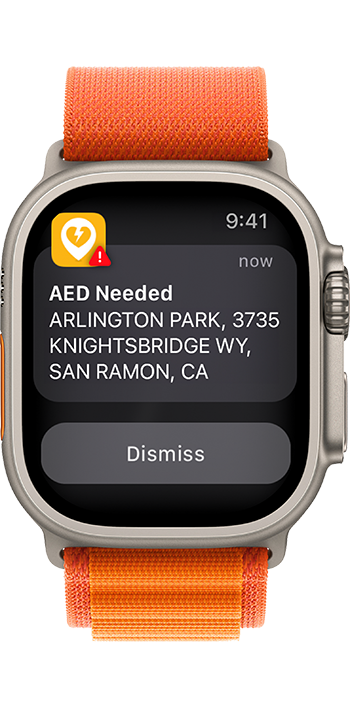
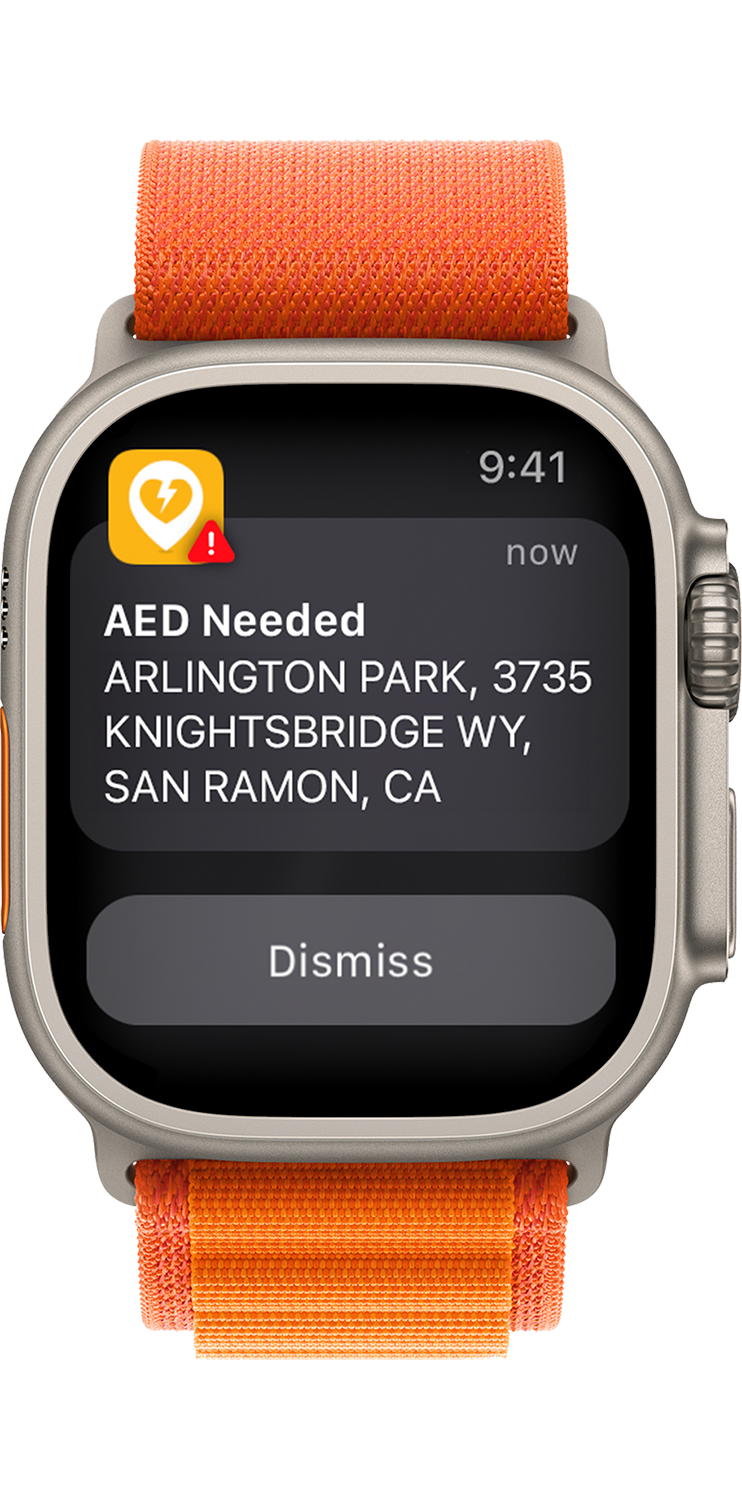
When a cardiac arrest occurs near a registered AED, subscribers to that device receive an AED-needed alert requesting they deliver the AED to the reported location.
- Industry-wide support for all AED manufacturers and models.
- Notifications are based on AED proximity to the cardiac event. No personal location sharing is used.
- AED-needed alerts appear on phones, watches, and tablets, and simultaneously across all signed-in devices.
- Multiple participants, such as a neighborhood AED program or workplace safety team, can subscribe to a single AED.
- Alerts can be set to critical, time-sensitive, or normal priority, with critical alerts able to override Do Not Disturb settings.
- View street-level imagery of where the AED is needed, including an interactive 360° daytime panorama of the destination address.
- Tap an AED icon for additional details, including device/cabinet image in the context of its surroundings, full location description, and accessibility information such as access codes and business/location hours.
- Responsible parties can independently test alerts with individual subscribers.
- AED-needed alerts are delivered through the PulsePoint Respond network of emergency communication center (ECC) integrations.






Accessible by design
PulsePoint designs its applications to be accessible to everyone.
Multilingual support is critical for access to life-saving resources. The NEAR Registry detects the device's language settings and automatically displays information in the user's preferred language.
Key accessibility features include scalable text, high-contrast color schemes, differentiation without color, clear and easily targetable touch areas, intuitive and simple gestures, consistent navigation and labeling, and full compatibility with screen readers and other assistive technologies.
T-AED
Telecommunicator guidance to nearby AEDs
POWERING TELECOMMUNICATORS WITH THE LOCATION OF EVERY AED
Emergency Communications Center (ECC) telecommunicators are a critical link in the cardiac arrest chain of survival. Similar to Telecommunicator CPR (T-CPR) instruction, telecommunicator guidance to AED locations (T-AED) can improve outcomes.
STRATEGIC INTEGRATIONS WITH INDUSTRY LEADERS
The NEAR Registry is integrated with leading emergency medical dispatch (EMD), pre-arrival instruction, and tactical map vendors, including ProQA Paramount, APCO Intellicomm, Total Response, ZOLL Dispatch, and RapidSOS Unite. These strategic integrations allow telecommunicators to inform callers of the exact location of registered AEDs within familiar applications and workflows.

Watch a webinar recording hosted by the International Association of Fire Chiefs. This webinar demonstrates how to incorporate the NEAR Registry and AED-Needed Alerts into existing cardiac arrest protocols in your ECC.
DEPLOY WITH CONFIDENCE
The NEAR Registry is a FirstNet Certified™ application. FirstNet Certified™ solutions must demonstrate 99.99% availability and pass independent third-party security, data privacy, and performance assessments.





Embed
Website Resources
More ways to connect
EMBED A LIVE NEAR RESOURCE MAP
PulsePoint agencies can embed a live, interactive resource location map directly within their website. The data for these maps comes straight from the NEAR Registry, always reflecting the latest information. These maps can provide single-agency or regional coverage.
EMBED A NEAR REGISTRATION FORM
PulsePoint agencies can embed a NEAR registration form within their website to let businesses and community members add an AED or other emergency resource. The simple-to-incorporate form offers an alternative to the NEAR Registry app for a small number of resources.
Resources can also be added directly to the registry by visiting aed.new in a browser.

API
Third-Party Integrations

Connecting partners
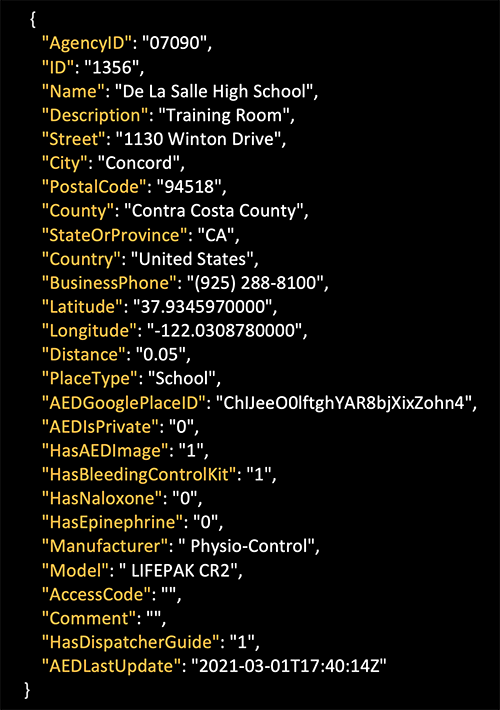
Third-party interfaces allow dispatch system vendors, EMD protocol providers, AED manufacturers, and other partners to connect and add value to the NEAR Registry.
NEAR REGISTRY ACCESS
The NEAR Registry API allows industry partners, such as telecommunicator medical guidance systems and call handling applications, to programmatically access resource records. These integrations let emergency telecommunicators inform 911 callers of nearby resource locations within familiar applications and workflows.
NEAR READINESS
The NEAR Readiness API allows industry partners, such as AED manufacturers and AED monitoring solution providers, to programmatically report readiness exceptions for registered devices, typically based on unattended sensor data. This proactively creates issue-specific maintenance tickets, known as Reported Issues, which surface in the registry's standard administrative workflow, including immediate push notifications to responsible parties. This reduces the chance that non-operational devices are recommended for use.
NEAR REGISTRATION
The NEAR Registration API allows AED distributors, program management companies, and other registry partners to create and update records programmatically. This makes it easy to report new installations and maintenance or inspection activity for compliance, and to share resource locations for emergency use.